There is an assumption woven so deeply into the personal development world that we rarely stop to question it.
When we want to change our lives, we begin by asking, What do I want?
What do I want to achieve? Where do I want to live? How much money do I want to earn? What kind of relationship, business, body, lifestyle or future do I want to create?
They are valuable questions. I ask them too.
But I believe there is a question that needs to come first.
Who is the person answering them?
Because if you have become disconnected from yourself, the goals you choose can look impressive on paper and still have very little to do with the life your soul is actually asking you to create.
You can build goals from family conditioning. From the rules you absorbed before you were old enough to question them. From what your industry rewards. From what society calls successful. From comparison. From fear. From the version of you who learned how to survive rather than the version of you who is ready to expand.
You can even become exceptionally good at achieving things you never really wanted.
And then one day, perhaps after years of doing everything “right,” you arrive somewhere you thought would make you happy and quietly wonder why it still feels hollow.
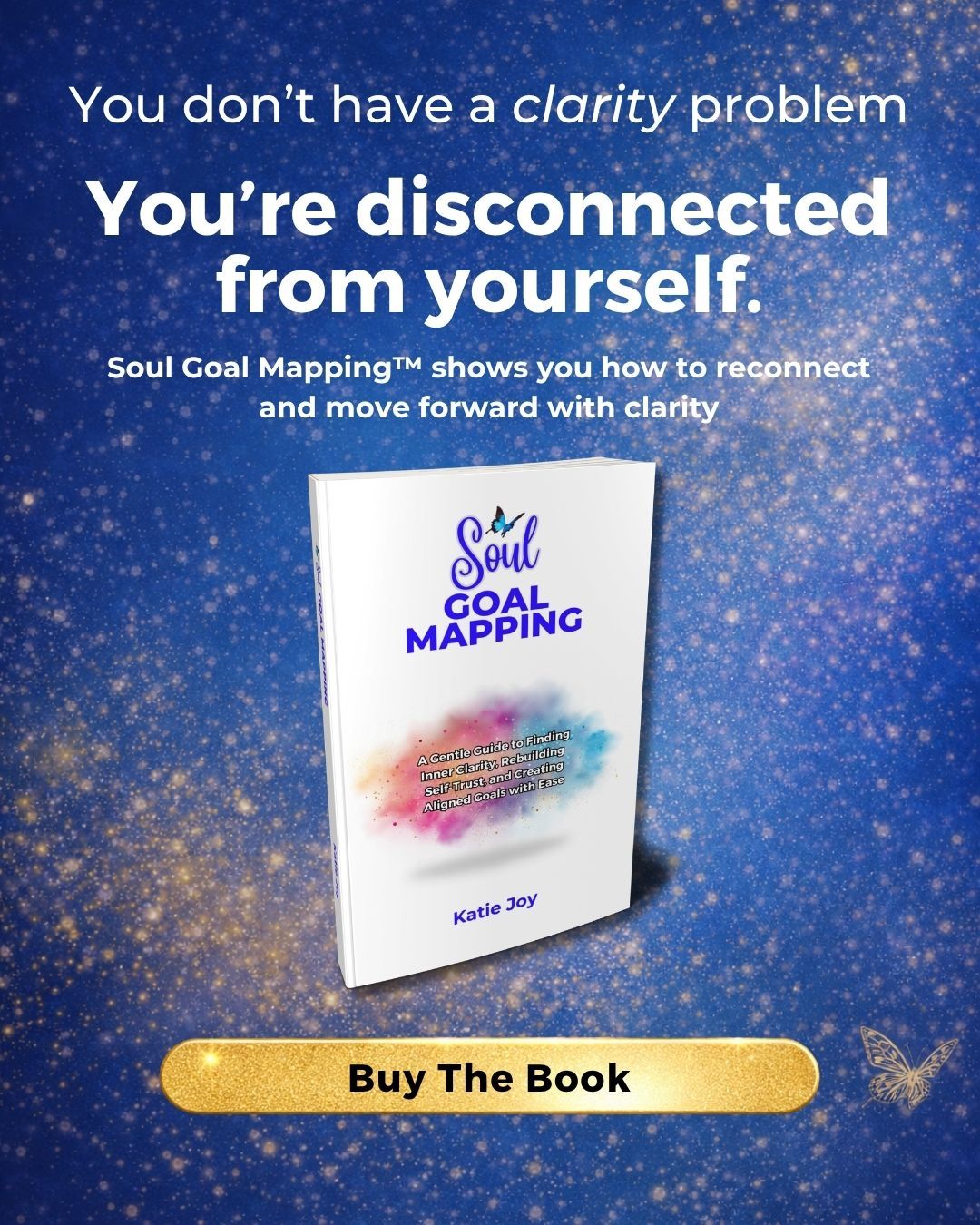
This is one of the reasons I created Soul Goal Mapping™.
I am deeply interested in goals, but I have never believed the destination is the most important part of goal setting.
I am interested in the person creating the destination.
I am interested in who you are becoming, what matters to you, what you can hear when the noise disappears, what you know before you start asking everybody else what they think, and whether the life you are building is actually an expression of who you are.
Before we create aligned goals, we need to reconnect with the person creating them.
Safety comes before strategy
Long before I became a coach, I was a paramedic.
When you walk into an emergency, you do not begin by shouting instructions from the doorway.
You assess.
You observe.
You notice what is happening beneath what is immediately visible.
And one of the first things I learned to bring into any scene was reassurance.
Someone may be frightened, injured, disoriented, embarrassed, overwhelmed or completely unsure of what is happening to them. My presence mattered before many of the clinical interventions did. A calm voice. Lack of judgement. Clear information. Helping someone understand that they were no longer alone in whatever was unfolding.
Creating enough safety for the next step to become possible.
That lesson never left me.
My professional path later took me through work connected with chiropractic care, psychology, human behaviour, personal development and coaching, but I can see now that there has been a thread running through all of it.
People move differently when they feel safe enough to be present with themselves.
Not safe because I can guarantee that nothing difficult will happen.
Not safe because life has suddenly become predictable.
Safe enough internally that discomfort no longer has to mean danger.
That distinction matters enormously when we begin talking about goals.
Because most people do not have a strategy problem.
They already know an extraordinary amount.
They have books stacked beside the bed. Podcasts saved on their phones. Courses they have completed. Notes they have taken. Plans they have written. They know they need to make the call, have the conversation, send the proposal, change the habit, publish the work, leave the situation, raise the price, ask for help or finally begin.
Intellectually, they often know exactly what to do.
And yet they don't move.
So they search for another strategy.
Another planner. Another formula. Another productivity hack. Another seven steps that might somehow remove the uncomfortable part.
But very often the thing standing between knowledge and movement is not a lack of information.
It is the internal state from which they are attempting to move.
Get comfortable being uncomfortable
I say this constantly:
Get comfortable being uncomfortable.
Because discomfort accompanies almost every meaningful expansion of identity.
The first time you do something new, speak differently, allow yourself to be seen differently or move beyond a familiar pattern, there is often a moment when your internal world protests.
This feels unfamiliar.
What if it doesn't work?
What if people judge me?
What if I get it wrong?
What if I succeed and then have to keep being this person?
And most people have become exceptionally skilled at escaping that moment.
They reach for their phone. They suddenly need to clean something. They research for another three hours. They decide the timing isn't quite right. They have another glass of wine. They start helping everyone else with their lives. They find another urgent task that conveniently prevents them from confronting the one thing that would actually move their own life forward.
The distraction gives them temporary relief.
But the cost of repeatedly escaping discomfort is disconnection.
Each time you abandon yourself at the exact moment expansion asks you to remain present, you reinforce the belief that discomfort means retreat.
And that creates a loop.
You feel called toward something. You move closer. Your nervous system encounters unfamiliarity. Fear appears. You distract yourself. The discomfort reduces. Nothing changes.
Then you judge yourself for not changing.
You know more. You understand more. You may even become frustrated because you can clearly see the gap between what you intellectually understand and what you are actually living.
This is where so many highly capable people get stuck.
Not because they lack intelligence.
Not because they lack ambition.
And certainly not because they need another person telling them to “just take action.”
They need to become capable of remaining connected to themselves while discomfort is present.
That is an entirely different skill.
Sometimes resistance is information
There is another layer here that I think gets lost when personal development turns every hesitation into something that needs to be bulldozed through.
Sometimes your resistance is fear of expansion.
And sometimes your resistance is wisdom.
If you keep attempting to force yourself toward a goal and something inside you repeatedly contracts, it is worth becoming curious before deciding you are lazy, undisciplined or self-sabotaging.
Whose goal is it?
Where did it come from?
Do you actually want the outcome, or have you decided you should want it?
Would you still choose it if nobody were watching?
Are you moving toward something that genuinely lights you up, or are you pursuing evidence that you are worthy, successful, safe or enough?
This is why reconnecting with yourself has to precede goal setting.
Otherwise, you can spend years trying to overcome resistance to a destination that was never truly yours.
When a goal is deeply connected to you, there can still be fear. There can still be discomfort. There can absolutely still be days when you would rather hide under the doona than take the next brave step.
Alignment does not eliminate challenge.
What it gives you is orientation.
There is something inside you that knows why you are moving.
Stop looking only for the steps of success
We live in a culture obsessed with steps.
Five steps to this. Seven steps to that. The blueprint. The framework. The formula. The morning routine of the millionaire. The funnel, the script, the launch plan, the manifestation method.
I love strategy. I have spent years building businesses and teaching people how to turn ideas into tangible reality. Practical movement matters.
But strategy does not exist in a vacuum.
Two people can follow the same steps and create completely different experiences—and completely different results—because the person executing the strategy matters.
This is why I teach what I think of as states of success, not simply steps for success.
Before I look at what I am doing, I pay attention to the internal place I am doing it from.
Am I creating from fear or possibility?
Urgency or trust?
Scarcity or sufficiency?
Proving or purpose?
Reaction or authorship?
Am I mentally rehearsing what I am frightened might happen, or am I orientating myself toward what I am deliberately creating?
This is what I sometimes describe as your energetic command centre.
It is the inner place from which you are perceiving, deciding and moving.
And it influences everything.
It influences the opportunities you notice. The conversations you are willing to have. The decisions you make. The boundaries you hold. The risks you interpret. The meaning you assign to temporary setbacks. Whether you stay connected to your vision when the external world has not caught up with it yet.
For me, tending to that internal orientation is not something I squeeze in after the “real work” is done.
It is part of the real work.
I regularly return to gratitude, possibility, clarity, trust, vision and the emotional experience of the future I am creating before I make strategic movement.
Not because I believe I can sit on the sofa and vibrate my way into an entirely new life.
Because the state I occupy changes the quality of the action I take.
Energy and action were never meant to be enemies.
When they are aligned, they become incredibly powerful partners.
Your internal state becomes your compass
I have worked with people who were outwardly successful and inwardly exhausted.
People who had built the business, reached the milestone, carried enormous responsibility and still felt strangely disconnected from the person living the life.
I have also watched clients experience significant shifts without necessarily changing everything on the outside first.
The shift begins when they stop treating themselves like a problem to solve and become willing to listen.
They begin recognising patterns rather than judging symptoms.
They notice the moments they leave themselves.
They become aware of what fear sounds like in their own mind. They learn the difference between intuition and reaction. They begin making decisions from the direction they are creating rather than allowing every temporary emotion to become a new set of instructions.
Their vision becomes a North Star.
An organising point.
Something capable of orientating the hundreds of tiny decisions that ultimately create a life.
Because our lives are rarely determined by one spectacular decision.
They are shaped by what we repeatedly orient toward.
If I am orientated toward fear, my decisions organise around protection.
If I am orientated toward proving myself, my decisions organise around validation.
If I am orientated toward avoiding discomfort, my decisions organise around remaining familiar.
And if I am deeply connected with myself and orientated toward a vision that feels true, my decisions begin organising around creation.
That does not mean fear disappears.
It means fear is no longer driving the vehicle.
Stop asking success to make you comfortable
One of the most significant shifts I have made in my own relationship with growth has been around capacity.
For a long time, like most people, I thought the goal was to become comfortable enough to do bigger things.
Now I see it differently.
I don't need every next level of my life to become comfortable.
I need to expand my capacity to hold it.
Because great success carries responsibility.
The business you say you want may require you to make decisions when there is no guarantee you are making the right one.
The visibility you want may require you to tolerate being misunderstood.
The money you want may require a completely different level of stewardship.
The freedom you want may require more personal responsibility, not less.
The relationship you want may require a level of vulnerability that feels far less comfortable than independence.
The dream you keep asking for may require you to become someone capable of holding far more uncertainty, opportunity, leadership, attention and choice than your present life demands.
So instead of continually asking, How can I make this feel comfortable? I have learned to ask:
How can I expand my capacity to remain connected to myself here?
That question changes everything.
It removes the assumption that discomfort is evidence something has gone wrong.
Sometimes discomfort is simply the sensation of your existing identity stretching around a life it has not held before.
You do not need to make yourself fearless.
You need enough internal stability to continue walking while fear has something to say.
The goal was never only the destination
This is what I wish more people understood about goal setting.
Your goals are not merely objects you are trying to acquire.
They are invitations.
They reveal your beliefs.
They expose your patterns.
They show you where you still look outside yourself for permission.
They introduce you to your relationship with uncertainty, worthiness, visibility, money, responsibility, trust and power.
And if you let them, they become a pathway back to yourself.
This is why Soul Goal Mapping™ begins before the traditional goal-setting conversation.
Reconnect.
Listen.
Notice.
Clear the noise that makes everybody else's voice louder than your own.
Then decide.
Then orientate yourself toward what you are creating.
Then develop the capacity to stay connected to it when fear, doubt, inconvenience and discomfort inevitably arrive.
This is not about becoming some permanently high-vibrational human who never has a difficult day.
I certainly don't.
It is about becoming increasingly skilled at recognising when you have disconnected from yourself and knowing how to return.
Again and again.
Because the people who create extraordinary lives are not necessarily the people who never wobble.
They are often the people who have learned not to build a permanent home inside the wobble.
They know how to recalibrate.
Before you choose the next goal
So before you write another list of what you want next, give yourself a moment.
Remove the audience.
Remove the expectations.
Remove the version of success you inherited.
Remove the timeline you think you are supposed to be following.
And come back to you.
What matters now?
What feels alive?
What keeps returning to you even when you try to dismiss it?
What future feels expansive enough that part of you is excited and another part is slightly terrified?
What are you ready to stop pretending you don't want?
And what are you pursuing simply because you once decided you should?
Then, once you have found the direction, pay attention to the person who will be walking toward it.
Tend to your internal world.
Strengthen your capacity.
Teach yourself that discomfort is survivable.
Let yourself discover that safety does not require certainty.
Stay connected to the vision long enough for your actions to begin organising around it.
Because there is a profound difference between chasing a goal from a place of disconnection and creating a life from a place of deep internal alignment.
That difference changes far more than what you achieve.
It changes who you become while achieving it.
And perhaps that was the point all along.
Soul Goal Mapping™ was created from this philosophy: reconnect with yourself, identify what is genuinely aligned with you, understand the patterns and energetic blocks that pull you away from it, and consciously orientate your life toward what you are here to create.
If you are ready to explore your goals from the inside out, you can begin with Soul Goal Mapping™ and discover a very different way of creating your next chapter.