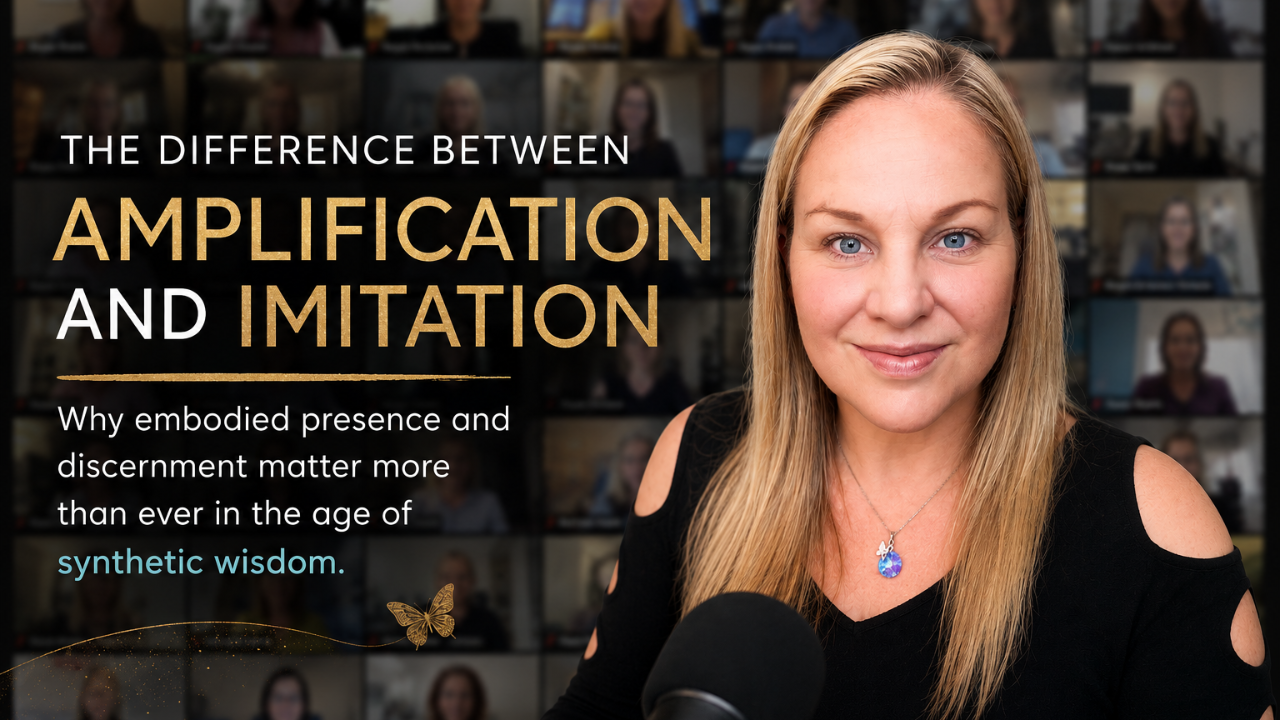
The Internet Is Becoming Saturated With Synthetic Depth
There is something happening online right now that many people can feel, but very few are talking about honestly.
The internet is becoming saturated with synthetic depth.
You can feel it in the endless stream of polished captions, rehearsed vulnerability, recycled “wisdom”, AI-generated insights, and coaches repeating the same language with slightly different branding colours and Canva templates. The words sound profound. The frameworks sound organised. The content sounds wise. But underneath it, something often feels… hollow.
And I think the reason more people are feeling unsettled by this is because AI is not just amplifying businesses. It is amplifying identity.
Including inauthenticity.
There Is a Difference Between Amplification and Imitation
Now before anyone decides I’m anti-AI, let me be very clear: I use AI every single day in my business. I use it to help me organise ideas, streamline workflows, repurpose live trainings into articles, and tighten systems that used to take hours of manual work. I actually love what it can do when it is used with integrity.
But there is a massive difference between amplification and imitation.
One strengthens your authentic voice. The other replaces it.
That distinction matters more than most people realise.
Over the past few years, I’ve watched more and more people in the coaching and personal growth space begin sounding eerily similar. The same phrases. The same concepts. The same emotional cadence. Sometimes even the same “breakthrough” language appearing shortly after being exposed to someone else’s work. It’s not new. I’ve experienced versions of this for over a decade. But AI has accelerated it dramatically because now people can imitate the appearance of depth faster than ever before.
Many People Are No Longer Building Businesses. They Are Building Identity Costumes.
That might sound harsh, but I don’t mean it from a place of bitterness. I mean it from years of observing patterns in human behaviour. People who have not yet anchored into their own identity will often reach for language, aesthetics, positioning, or philosophies that feel powerful when they stand near them. In the short term, it can even work. They can sound insightful online. They can create polished content. They can appear confident and organised.
But eventually there comes a moment where they need to be fully visible.
Live.
Unscripted.
In relationship with real humans.
And that is where the cracks begin to appear, because presence exposes incongruence.
Imposter Syndrome Scales
One of the things I often say to my clients is that “imposter syndrome scales.” If your identity is not genuinely anchored into the work you are teaching, visibility does not solve that problem. It amplifies it. The bigger the audience becomes, the louder the internal wobble becomes too.
So what often happens is people unconsciously hide behind content. They become addicted to polishing instead of facilitating. They over-consume information instead of embodying wisdom. They endlessly reposition themselves instead of deepening into who they actually are.
AI is making it easier to sound wise without becoming wise.
That is one of the biggest tensions we are now facing as a society.
Conversational Healing™ Is Not Information. It Is Embodied Facilitation.
One of the phrases I coined years ago to describe my work is Conversational Healing™.
Because what happens inside these live spaces is not simply “coaching” or information delivery. It is real-time nervous system recalibration, pattern recognition, emotional safety, identity integration, and energetic reorganisation happening through deeply present human conversation.
Recently inside one of my live programs, I facilitated a spontaneous hot seat process with a woman who had been triggered by a bullying experience connected to a younger version of herself. Interestingly, at the exact same time in my personal life, my own nine-year-old son had been navigating bullying experiences too. The synchronicity of it was impossible to ignore. As she shared vulnerably with the group, I could feel how many other people in the room were silently mirroring pieces of the same wound within themselves.
What unfolded over the next hour was not “content.” It was not a perfectly structured coaching script. It was live facilitation. Nervous system recalibration. Breathwork. Awareness. Identity shifts. Emotional safety. Energetic reorganisation.
And the fascinating thing was this: the transformation wasn’t isolated to the woman in the hot seat. Everyone in the room shifted with her.
That is the difference between information and embodied facilitation.
This is also why I often say that support alone does not create transformation — participation does. Awareness matters deeply, but insight without embodied participation can still leave someone emotionally and energetically stuck.
Real Transformation Changes the Way You Meet Yourself When Nobody Else Is Watching
Afterwards, several participants messaged me saying they had experienced breakthroughs simply from witnessing the conversation unfold. One woman shared that she had struggled with anxiety patterns for years, particularly around sleep and pressure to perform perfectly. She described how, instead of spiralling into fear that night, she consciously used the nervous system tools we had practised together during the call. She breathed. She regulated herself. She spoke lovingly to the younger version of herself instead of attacking herself.
That is what real transformation looks like.
Not just consuming another motivational quote.
Not another dopamine hit of inspiration.
Not endlessly collecting information while remaining emotionally fragmented underneath.
Real transformation changes the way someone meets themselves when nobody else is watching.
And I think that is exactly what many people are truly starving for right now.
People Are Craving Spaces Where They Can Safely Exhale Again
Not more noise.
Not more polished content.
Not more perfectly curated online identities.
People are craving spaces where they can safely exhale again.
Spaces where they do not have to perform.
Spaces where they can feel seen instead of managed.
Spaces where they can reconnect with their own intuition underneath the overwhelm.
The irony is that while AI becomes more intelligent, many humans are becoming more disconnected from themselves. Some people are now outsourcing not only tasks to AI, but discernment, decision-making, emotional processing, self-trust, creativity, and even identity formation.
I’ve had conversations recently where people shared that family members now turn to AI for emotional support instead of real human relationships. And while technology absolutely has its place, we need to be honest about something: convenience and connection are not the same thing.
The Future Premium Is Not Information. It Is Discernment.
Information is now infinite. Wisdom is not.
Wisdom still requires embodiment. It requires lived experience. It requires nervous system safety. It requires integration. It requires the willingness to sit with discomfort long enough for genuine transformation to occur instead of bypassing it with another dopamine hit of inspiration.
This is also why I believe businesses that survive and thrive in the next era will not necessarily be the loudest. They will be the most congruent.
The coaches who survive this era will be those whose presence matches their content.
People can feel the difference now. Maybe not always consciously at first, but energetically they can feel it. They can feel when someone is speaking from lived truth versus borrowed language. They can feel when someone’s nervous system is regulated versus performing confidence while internally fragmented. They can feel when someone genuinely holds space versus simply delivering information.
AI Cannot Replace Embodied Presence
And this is where I think many authentic leaders need to stop panicking about AI and instead deepen into what makes them irreplaceably human.
AI cannot replicate embodied presence.
It cannot co-regulate a room.
It cannot intuitively attune to the subtle shifts happening in a live collective space.
It cannot replace the transformation that happens when someone finally feels safe enough to stop abandoning themselves.
What it can do brilliantly is amplify what is already there.
So if someone has deep integrity, clear values, genuine lived experience, strong systems, and a real desire to serve, AI can absolutely help them reach more people and reduce overwhelm. But if someone is disconnected from themselves, mimicking others, avoiding their own inner work, and chasing significance through appearance, AI will amplify that too.
The Real Invitation of This Era Is to Become More Deeply Human
Which is why I believe the real invitation of this era is not to become more artificial in order to compete with technology.
It is to become more deeply human.
To slow down enough to hear your own thoughts again.
To reconnect with your own intuition.
To create from lived experience instead of imitation.
To stop outsourcing your identity.
To stop abandoning yourself for approval.
To build businesses and lives that are congruent with who you truly are.
Because in a world overflowing with synthetic wisdom, authentic presence becomes unforgettable.
If You’re Tired of Noise, Performance, and Trying to “Fix” Yourself…”
This is exactly why I wrote Soul Goal Mapping™.
Not as another book filled with surface-level motivation or endless information overload, but as a guided recalibration back to yourself.
Because most people don’t need more content.
They need clarity.
They need nervous system safety.
They need space to recognise the patterns they’ve been operating from so they can finally move forward from a place that actually feels true.
If this article resonated deeply with you, you can explore the book and read Chapter One here:
“Read Chapter One — it might feel different than anything you’ve read before.”